






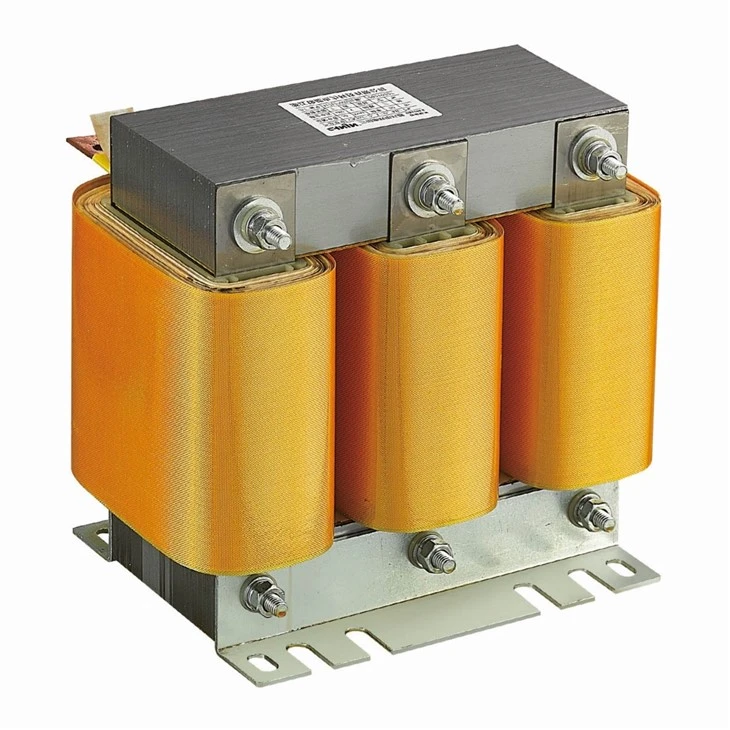
AC Output Foil Wound Reactor
✅ Limits dv/dt– Protects motor insulation from fast-rising PWM pulses.
✅ Reduces Harmonic Distortion – Smooths current waveform, minimizing motor heating.
✅ Suppresses Voltage Overshoot – Prevents reflected wave issues in long cable runs.
✅ Improves EMI Performance – Reduces high-frequency noise radiation.
✅ Class H (180°C) Insulation

- Product Introduction
AC output foil wound reactor is an inductive component installed at the output side of a Variable Frequency Drive (VFD) or inverter. It is designed to reduce voltage spikes, limit dv/dt, and protect motors from high-frequency harmonics caused by PWM switching.
Key Features and Functions
✔ Limits dv/dt– Protects motor insulation from fast-rising PWM pulses.
✔ Reduces Harmonic Distortion – Smooths current waveform, minimizing motor heating.
✔ Suppresses Voltage Overshoot – Prevents reflected wave issues in long cable runs.
✔ Improves EMI Performance – Reduces high-frequency noise radiation.
Typical applications:
● VFD-to-Motor Connections (Especially with long cables >50m)
● Servo Drives & Industrial Automation
● Elevator & Crane Motor Systems
● Renewable Energy Inverters
Electrical Characteristics
| Parameter | Typical Value |
|---|---|
| Inductance (L) | 1–300 mH |
| Current Rating | 10A–1000A+ |
| Frequency Range | 1kHz–20kHz |
| Voltage Rating | 400V, 690V, 1000V |
| Impedance ratio (%) | 3%,5%,7%,14% |
| Saturation Current | 1.75 × I₁ |
| Inductance tolerance | -5% ~ +5% |
| Insulation class | H(180℃) |
AC Input Reactor vs. AC Output Reactor: Detailed Comparison
| Feature | AC Input Reactor | AC Output Reactor |
|---|---|---|
| Installation Location | Grid input side of VFD/inverter | Motor output side of VFD/inverter |
| Primary Function | Suppresses grid harmonics, protects VFD | Protects motor, reduces voltage spikes & reflected waves |
| Target Issues | Input-side harmonics (5th/7th/11th), voltage fluctuations | PWM-induced high-frequency noise, long-cable reflections (dv/dt) |
| Typical Inductance | 1-5% impedance (at 50/60Hz fundamental) | 3-5% impedance (for PWM switching freq.) |
| Current Frequency | Line frequency (50/60Hz) + low-order harmonics | High frequency (1kHz-20kHz PWM carrier) |
| Core Material | Silicon steel (low-frequency loss) | Silicon steel or nanocrystalline (better high-frequency performance) |
Input reactors act as a "firewall" for the grid; output reactors are "armor" for motors.
They are not interchangeable-select based on system requirements!
Selection guide
● Step1:Determine inductance value
Rule of Thumb:

● Step2:Current rating
Must exceed motor FLA (Full Load Amps) + harmonic content.
For high overload applications, use 150% derating.
● Step3:Voltage and insulation class
600V class for standard 400V systems.
1000V+ for medium-voltage drives.
● Step4:Cable length consideration
Short cables (<50m): May not need a reactor.
Long cables (>50m): Essential to prevent voltage reflection.
Pls contact us for more guidelines
Quality ensurance
Product quality assurance:
1. Strict raw material quality control to eliminate quality problems at the source.
2. Advanced production equipment to ensure product quality.
3. High standard product inspection to ensure the efficient and normal use of products.
4. Standardised management to ensure the smooth and normal operation of the production process.
5. Professional R&D team, continuous research and innovation to meet to various market requirements.

Hot Tags: ac output foil wound reactor, China ac output foil wound reactor manufacturers, suppliers, factory, AKSG, AKSG Variable Frequency Output Electrical Reactance, AKSG AC Variable Frequency Input Line Reactor, reactor for machining, reactor for cutting, reactor in electrical system


