




Low voltage grid reactive power compensation cabinet
 Jan 15, 2026|
 In recent years, the rapid growth of electricity load has led to tight power supply, making it particularly important for power supply companies to maximize the capacity of power transmission and distribution equipment. Additionally, power users are increasingly demanding higher power quality, and reducing electricity costs as well as lowering production expenses remain constant objectives for them. All these factors have created an urgent need to improve power factor.
Power factor is a fundamental concept that reflects the effective utilization of apparent power output from the source and serves as a critical indicator for electrical equipment. Improving the power factor of users holds significant importance for enhancing the economic efficiency of power operations and conserving electrical energy.
Electrical loads in the power grid, such as motors and transformers, are mostly inductive. During operation, these devices require corresponding reactive power, leading to a large amount of reactive current in the grid. Reactive current generates reactive power, imposing an additional burden on the grid and affecting power supply quality. Therefore, adopting reactive power compensation is an effective measure to improve power factor, conserve electrical energy, reduce operational costs, and enhance power quality.
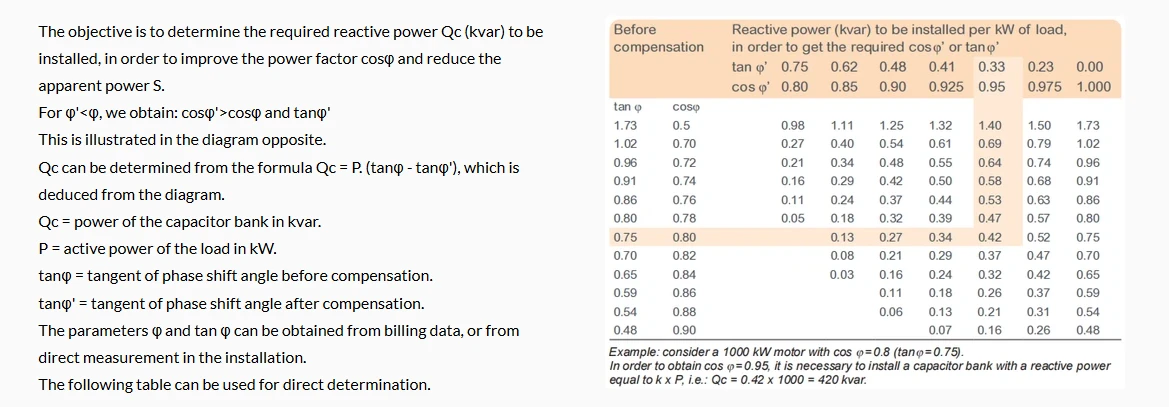
Significance of Reactive Power Compensation
By improving the power factor, the total current in the lines and the capacity of electrical components in the power supply system-such as transformers, electrical equipment, and conductors-are reduced. This not only lowers investment costs but also reduces energy losses.
(1) Reducing Power Losses: Typically, power losses in factory power distribution lines range from 2% to 3%, depending on the line and load conditions. Using capacitors to improve the power factor reduces the total current, thereby decreasing power losses at both the supply and consumption ends.
(2) Improving Power Supply Quality: Enhancing the power factor reduces the total load current and voltage drops. Installing capacitors on the secondary side of transformers can improve the power factor and increase the secondary side voltage.
(3) Extending Equipment Lifespan: After improving the power factor, the total line current decreases, reducing the load on nearly or already saturated equipment such as transformers and switches, as well as line capacity. This lowers operating temperatures and extends lifespan (for every 10°C reduction in temperature, lifespan can double).
(4) Ultimately Meeting Monitoring Requirements for Reactive Power Compensation: This eliminates penalties imposed due to excessively low power factors.
Types of Compensation Based on Capacitor Installation
Based on the installation method of capacitor banks, compensation can be categorized as: centralized compensation, group-based decentralized compensation (distributed decentralized compensation), and individual decentralized compensation.
(1) Centralized Compensation:
Several sets of capacitor panels are installed in high and low-voltage distribution rooms. The capacitors are connected to the distribution busbars to compensate for reactive power within the supply range. This method compensates for all loads supplied by the high and low-voltage distribution rooms. It is typically installed in the user's main substation and serves as the primary foundational compensation for the user, balancing the reactive power capacity of the entire plant.
(2) Group-Based Decentralized Compensation (Distributed Decentralized Compensation):
Capacitors are connected to the busbars of high-voltage distribution devices or power distribution cabinet to compensate for reactive power of the electrical equipment supplied by these GGJ low voltage reactive power compensation cabinet. This method is often installed in the user's workshop substations or workshop power distribution cabinet and is an important compensation method for the user. It balances the reactive power capacity within the workshop.
(3) Individual Decentralized Compensation:
Capacitors are installed in cabinet placed near the motor for individual compensation. The capacitors are directly connected to the motor terminals or the end of protective equipment. This method generally does not require separate operation and protection devices for the capacitors and is referred to as direct individual decentralized compensation. For frequently operated equipment, contactors are used; for infrequently operated equipment, air circuit breakers are used to start the compensated equipment simultaneously. For high-voltage capacitors used in direct individual decentralized compensation, vacuum switches are preferred. When control devices are not used, the motor control switch operates the capacitors, but the capacitors must be equipped with internal fuses or separate fuses. The use of control devices is often applied to motors with special operational requirements, such as reduced-voltage starting or reversible operation. This method serves as key compensation for the user's large electrical equipment.
Low-voltage automatic reactive power compensation and harmonic suppression devices (hybrid compensation cabinets) play a role in improving the power factor of the power grid, reducing losses in supply transformers and transmission lines, enhancing power supply efficiency, and improving the power supply environment. Therefore, reactive power compensation devices hold an indispensable and crucial position in power supply systems. Reasonable selection of compensation devices can reduce network losses and improve grid quality.
Product Advantages and Features
1.Uses a reactive power controller, enabling manual/automatic control.for example,jinneng JKWD5 Automatic reactive compensating controller is specifically designed for low voltage 400V distribution networks
2.Our Low voltage Intelligent Power Factor controllers supports switching methods such as cyclic switching, coded switching, and sequential switching.
3.Monitors real-time system parameters such as voltage, current, power factor, and compensation status.
4.Switching delay is adjustable from 0 to 120 seconds. For special requirements, the switching cycle can be as fast as 1 second.
5.Includes comprehensive protection measures against overvoltage, undervoltage, overcurrent, short circuits, and misoperation.
6.Effectively avoids capacitor resonance and diverts approximately 20% to 30% of characteristic harmonic currents.
7.Low investment cost, mature technology, stable performance, and suitable for most low-voltage compensation scenarios.