




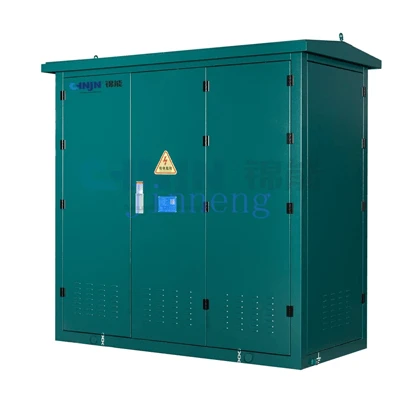

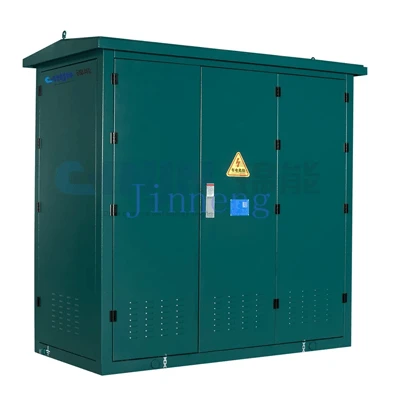
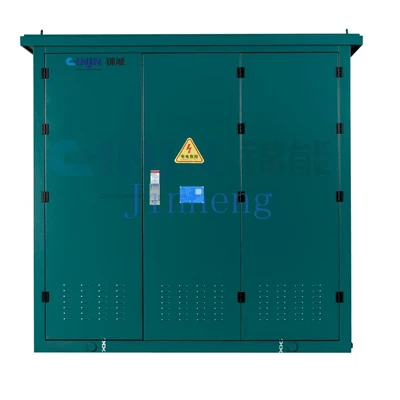
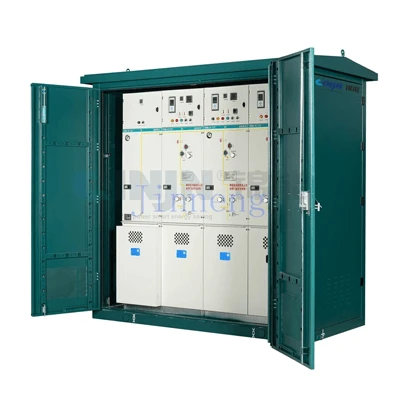
Switch Station
A switching station (often referred to as a power switching station) is a vital component of the urban power grid, acting essentially as an electricity "transfer station" or "dispatch hub." Although switching station does not contain transformers and does not alter voltage levels, it plays a critical role in receiving, distributing, and controlling the flow of electrical energy.

- Product Introduction
A switching station (often referred to as a power switching station) is a vital component of the urban power grid, acting essentially as an electricity "transfer station" or "dispatch hub." Although switching station does not contain transformers and does not alter voltage levels, it plays a critical role in receiving, distributing, and controlling the flow of electrical energy.
The primary function of a switching station is to consolidate and redistribute power at a single voltage level. By doing so, it enhances the reliability, flexibility, and cost-efficiency of the power supply, making the switching station a foundational node in modern smart distribution networks.
Functional Traits
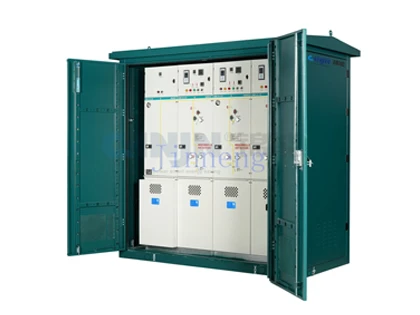
Power Collection and Distribution: It aggregates and redistributes multiple medium-to-high voltage lines (typically 10kV or 20kV) coming from upper-level substations, directing power to surrounding end-users or lower-level distribution facilities.
Enhancing Power Supply Reliability:
Redundant Incoming Lines: Switching stations are typically fed by two or more incoming lines, creating a ring network (or loop) structure. If one power source fails, the system can rapidly switch to a functional line, minimizing or entirely preventing service interruptions.
Fault Isolation: In the event of a failure, the station can quickly disconnect the compromised outgoing line to isolate the fault, ensuring that the rest of the network continues to operate normally.
Monitoring and Protection: Equipped with relay protection devices and advanced monitoring systems, the station tracks parameters like current and voltage in real time to diagnose faults and automate power restoration.
Optimizing Substation Outgoing Corridors: By placing switching stations directly within high-load centers, grid operators can maximize the efficiency of existing high-voltage feeder lines. This distributes energy closer to a larger number of users while significantly alleviating the physical overcrowding of line corridors leaving the main substation.
Main componenets
Main componenets
1
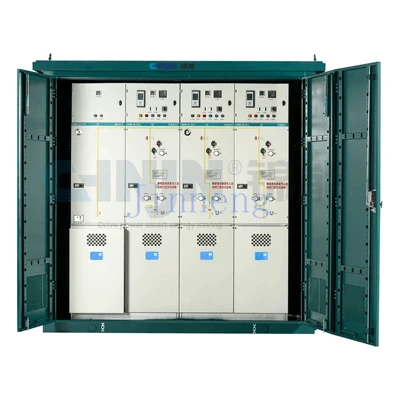
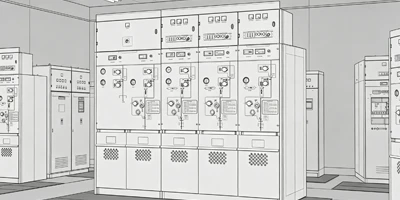
Switchgear (Core Equipment)
AIS (Air-Insulated Switchgear): The traditional configuration, which uses atmospheric air for insulation and requires a relatively large physical footprint.
GIS (Gas-Insulated Switchgear): A highly reliable, compact alternative that uses sulfur hexafluoride ($\text{SF}_6$) or alternative eco-gases for insulation, drastically reducing the required footprint.
2
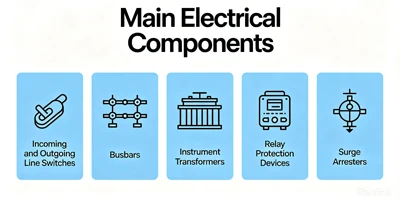
Main Electrical Components
Incoming and Outgoing Line Switches: Typically load-break switches or circuit breakers used to connect, disconnect, or interrupt fault currents.
Busbars: Heavy-duty conductors that serve as common electrical junctions to collect and redistribute energy across multiple circuits.
Instrument Transformers: Includes CTs (Current Transformers) and PTs / VTs (Potential/Voltage Transformers), which step down high currents and voltages to safe levels for metering, measurement, and relay protection.
Relay Protection Devices: Intelligent systems that monitor the grid for abnormal conditions and automatically issue trip commands to circuit breakers during a fault.
Surge Arresters: Used to protect downstream equipment from lightning strikes and transient overvoltage spikes. (Note: Fuses protect against overcurrents; surge arresters are used for lightning/overvoltage).
3
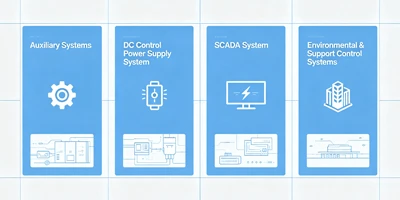
Auxiliary Systems
DC Control Power Supply System: A dedicated battery-backed system that ensures uninterrupted power is available for protection relays and breaker trip/close operations.
SCADA System (Supervisory Control and Data Acquisition): Provides comprehensive automation by enabling remote telemetry, signaling, control, and regulation (often referred to as the "four remotes").
Environmental & Support Control Systems: Integrates HVAC/ventilation, station lighting, automated fire suppression, and facility security (including access control and CCTV video surveillance).
Products parameters
product parameters
| Technical Parameter | Description |
| Rated Voltage Level | Standard rated voltage levels for medium-voltage switchgear: 10kV, 20kV, 35kV, etc. |
| Rated Current | Standard rated current range: from hundreds to thousands of amperes (A) |
| Rated Short-Circuit Withstand Current | Rated r.m.s. value of short-circuit withstand current, in kiloamperes (kA) |
| Rated Insulation Level | Rated insulation level, including power frequency withstand voltage and lightning impulse withstand voltage |
| Rated Operating Frequency | Rated AC operating frequency: 50Hz or 60Hz |
| Equipment Insulation Type | Medium-voltage switchgear insulation type: Air-insulated switchgear (AIS) or Gas-insulated switchgear (GIS) |
| Main Switching Device Type | Main switching device types: Load-break switch, vacuum circuit breaker, SF₆ gas circuit breaker, etc. |
| Busbar Arrangement Configuration | Standard busbar arrangement configurations: Single busbar, double busbar, single busbar with sectionalizer, etc. |
| Protection Relay Configuration | Protection relay configuration: Types and number of integrated protection relays, including overcurrent, short-circuit, earth fault protection, etc. |
| Rated Environmental Operating Conditions | Rated environmental operating conditions: Operating temperature range, relative humidity, altitude, pollution degree, etc. |
| Rated Voltage Level | Standard rated voltage levels for medium-voltage switchgear: 10kV, 20kV, 35kV, etc. |
Switching Station VS Substation
| Feature | Switch Station(开闭所) | Substation(变电站) |
| Core Function | Distribute and route electrical power (same voltage level) | Transform, distribute, and control electrical power (different voltage levels) |
| Voltage Change | No (Input and output voltage are the same, e.g., 10kV in, 10kV out) | Yes (Core function, e.g., steps down 110kV to 10kV, or steps up voltage) |
| Key Equipment | Switchgear (load switches, circuit breakers, isolators), protective relays | Transformer (core), switchgear, capacitor banks, reactive power compensators, monitoring systems |
| Transformer Presence | No (may have a small distribution transformer only for auxiliary power) | Yes (Core equipment for changing voltage levels) |
| Scale & Level | Relatively small scale, usually at the distribution network level (medium voltage, e.g., 10kV/35kV) | Varies widely, covering all levels from transmission to distribution network (from EHV 500kV to LV 0.4kV) |
| Proximity to Users | Closer to end-users, typically supplying a district, several buildings, or large facilities | Farther from users (HV substations) or directly near users (distribution substations) |
Testing equipment

Business partners
We are proud to cooperate with leading global and domestic enterprises across the energy, grid infrastructure, industrial, and telecommunications sectors:
Power Grids & Utilities: State Grid Corporation of China (SGCC), China Southern Power Grid (CSG).
Power Generation & Energy: China Huaneng Group, SDIC Power, China Huadian Corporation (CHD), China Energy Investment (Guodian), China Three Gorges Corporation (CTG), China Resources Power (CR Power).
Oil, Gas & Nuclear: Sinopec, PetroChina, China National Nuclear Corporation (CNNC).
Industrial, Construction & Tech: Siemens, ThyssenKrupp (TK), AUX Group, China Railway Group (CREC), China Railway Construction Corporation (CRCC), China Mobile, LG (Life's Good), Tianneng Battery.

Hot Tags: switch station, China switch station manufacturers, suppliers, factory, assembled electric enclosures with ventilation, assembled electric mounting brackets with adjustable angle, uninterrupted power supply, box type substation and transformer, electrical power, flame retardant cables assembly


