




Intelligent vs. Conventional Power Capacitors: Core Differences, Key Benefits & Selection Guide
 Aug 15, 2026|
 When designing or upgrading electrical power systems, choosing the right reactive power compensation technology is critical for energy efficiency, equipment lifespan, and grid stability.
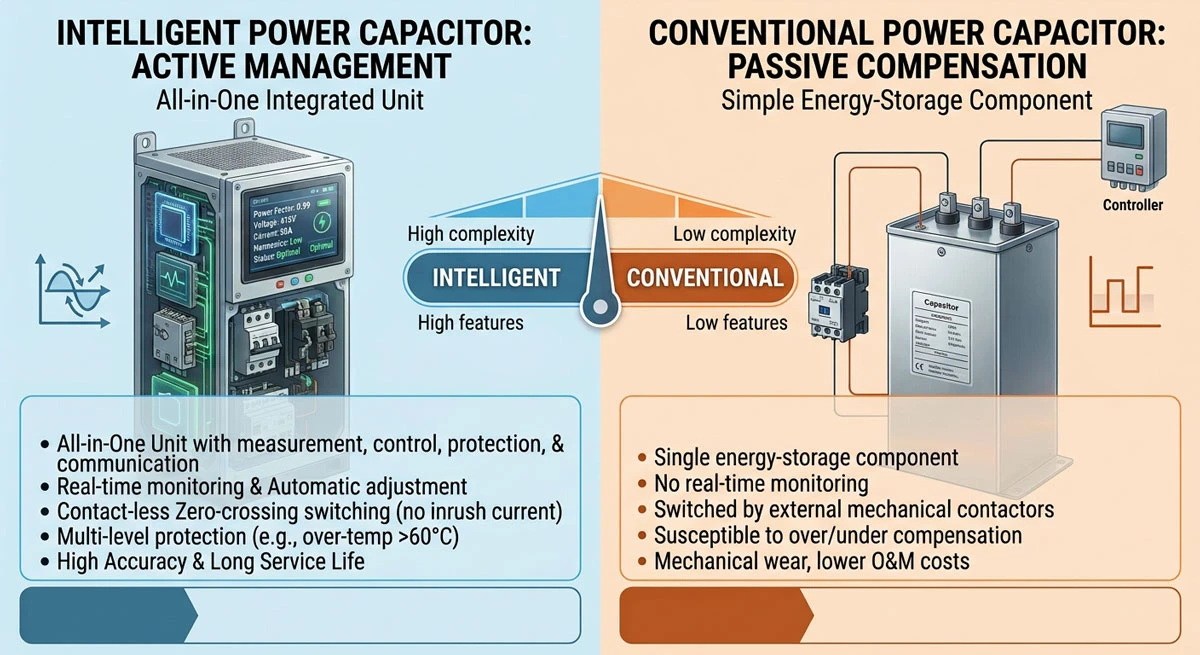
The fundamental difference lies in their architecture: an intelligent power capacitor is a complete, self-contained compensation system with integrated measurement, control, protection, and communication capabilities. In contrast, a
conventional capacitor is purely a passive energy-storage component.
Here is a detailed comparison of their structural design, functionality, performance, applications, and long-term costs.
1. Structural Design: Component vs. Integrated System
- Conventional Capacitors (Passive Components): Designed with a simple, bare-bones structure consisting of metal electrodes, insulating dielectric material, and a protective enclosure. As passive energy storage units, they only offer fixed reactive power output and require external controllers, contactors, and protection gear to function.
- Intelligent Capacitors (All-in-One Systems): Break away from traditional piecemeal setups. Encapsulated within a single compact housing, an intelligent unit integrates:
This smart architecture allows the unit to continuously execute real-time monitoring, automatic adjustment, and instant fault self-diagnosis out of the box.
2. Functional Comparison: Passive Compensation vs. Active Management
While conventional units offer basic reactive power support, intelligent capacitors transform passive hardware into an active power quality management system.
Conventional Capacitors
- Manual or Basic Control: Switched on and off strictly through external mechanical contactors.
- No Real-Time Insights: Lack self-monitoring or dynamic auto-adjustment.
- Vulnerable to Fluctuations: Rigid switching leads to frequent over-compensation or under-compensation during dynamic load shifts, degrading power quality.
Intelligent Capacitors
- Dynamic Real-Time Monitoring: Continuously tracks voltage, current, power factor , and harmonic distortion to auto-switch capacitor steps.
- Inrush-Free Zero-Crossing Switching: Uses advanced thyristor/solid-state switching devices to engage at the voltage zero-crossing point, eliminating damaging current surges and system voltage sags.
- Multi-Level Hardware Protection: Protects against over-voltage, under-voltage, phase loss, harmonic overload, and thermal stress (automatically disconnecting if internal temperature exceeds 60 °C).
- Smart Communication Protocols: Supports RS485 and MODBUS protocols, allowing seamless integration with SCADA or Building Management Systems (BMS) for remote control and telemetry.
- Self-Diagnosis & Rapid Fault Isolation: Instantly detects internal abnormalities and trips itself off the grid before damage propagates.
3. Performance Breakdown: Accuracy, Lifespan & Stability
Compensation Accuracy
Intelligent capacitors continuously adapt to load swings, maintaining a near-unity power factor without hunting. Conventional capacitors struggle with varying loads, which can lead to utility power factor penalties and increased line losses.
Service Life and Maintenance Costs
Because intelligent capacitors utilize contact-less zero-crossing switching, they eliminate mechanical arcing, drastically extending operating life and lowering OpEx. Mechanical contactors on conventional units suffer rapid contact erosion under frequent switching, driving up maintenance overhead.
4. Ideal Application Scenarios
Choose Intelligent Capacitors For:
- Dynamic Industrial Environments: Automated manufacturing, robotics, and variable speed drive (VSD) heavy facilities.
- Mission-Critical Infrastructure: Data centers, healthcare facilities, high-rise commercial complexes, and microgrids.
- Harmonic-Rich Networks: Installations with non-linear loads requiring precise, digitally monitored reactive power.
Choose Conventional Capacitors For:
- Stable Load Profiles: Small-to-medium factories, agricultural pumping stations, and simple rural distribution grids.
- Budget-Constrained Projects: Applications where upfront capital expenditure (CapEx) is the primary deciding factor and load variations are minimal.
5. Buyer's Warning: Vendor Lock-In & Conversion Risks
Before specifying or purchasing intelligent capacitors, electrical engineers and facility managers should evaluate two critical operational risks:
1. Proprietary Vendor Lock-In
The all-in-one nature of intelligent capacitors creates dependency on the original manufacturer. If a module fails, replacing it often requires the exact same brand and model.
Cross-brand replacements usually require re-tuning system communications or swapping out matching master controllers. If a vendor discontinues a model line, facility owners may face costly upgrade pathways or full bank replacements.
2. Retrofit & Replacement Complexity
Replacing a failed intelligent capacitor with a conventional capacitor is not a plug-and-play operation. It requires adding external contactors, fuse blocks, wiring harnesses, and a central power factor controller.
⚠️ Safety Hazard: Direct retrofitting without complete system re-engineering can lead to severe electrical parameter mismatches, equipment instability, and fire hazards.
Summary & Final Recommendation
Choosing between intelligent and conventional capacitors comes down to load profile, power quality standards, and budget constraints:
Opt for Intelligent Capacitors if you require precise power factor control, dynamic load tracking, minimal downtime, and low long-term maintenance costs in a complex grid environment.
Opt for Conventional Capacitors if you are operating on a tight initial budget with simple, stable electrical loads that do not experience rapid switching or harmonic disruption.